Hepatitis D virus (HDV) | GileadPro

Hdv banner

HDV (Hepatitis D virus)

What is hepatitis D and the potential consequences for your patients?

Overview of Hepatitis D


Hepatitis D is an inflammation of the liver caused by the hepatitis D virus (HDV), which only infects those living with hepatitis B virus (HBV).1

HDV structure and the role of HBV in its lifecycle

HDV requires the presence of hepatitis B surface antigen (HBsAg) to form HDV virions enabling de novo entry into hepatocytes and dissemination of infection.2,3

Once inside the liver cell, the hepatitis delta virus genome (1.7 kb) is too small to encode an RNA-dependent RNA polymerase and relies on the host machinery to replicate.2-4
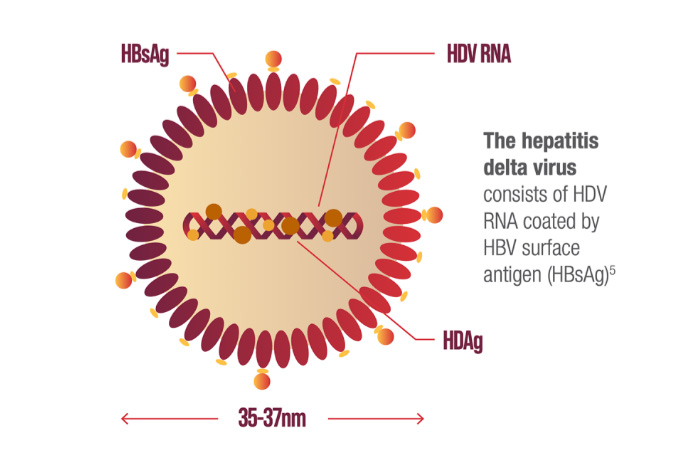
THE HEPATITIS DELTA VIRION

image

HDV transmission can occur through several routes 6,7

test

HDV prevalence and epidemiology


HDV affects millions of people around the globe and its prevalence is likely underestimated.8-10

It is estimated that HDV affects between 4.5% and 13% of HBsAg-positive patients.11,12

In the UK, the prevalence in those who are HBsAg +ve is estimated to be between 2.1% and 9.9%.13,14

Current available data suggests that HDV is most prevalent in Central Asia, Eastern Europe, Central Latin America, and West and Central Africa.11

There are several factors that contribute to the lack of accurate estimates:8-10

  • No universal HDV screening of HBsAg-positive individuals
  • Lack of accuracy and standardised confirmatory tests
  • Variable estimates from individual countries
  • HBV prevalence underestimated and lack of HBV central UK registry.

Data suggest that people living with HDV in the UK typically originate from other countries15,16

Nearly all people living with HBV with active HDV infection identified in London had immigrated to the UK.15

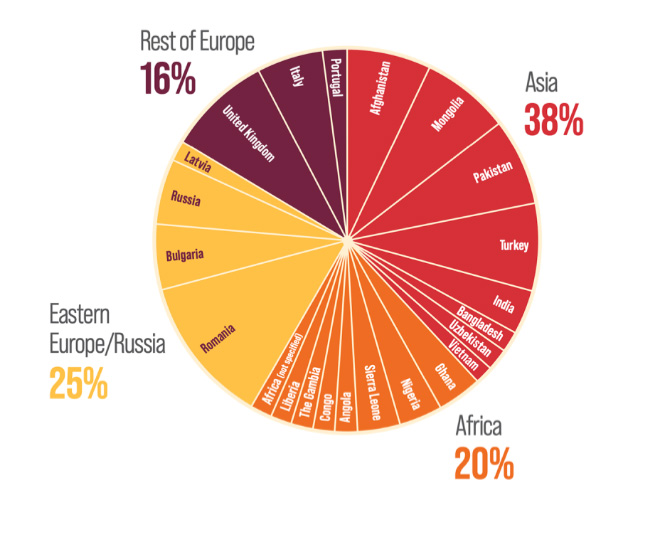
  • A cross-sectional study of HDV screening rates in people with HBV attending 4 London hospitals from January 2005 to June 2012a found that between 4.5% (n=158/3543) and 6% (n=4/67) of patients were seropositive for HDV b, with 91% (n=50/55) of people with active HDV infectionc originating from outside the UK.15

1 in 3 people living with HBV in West Scotland originated from outside the UK.16
  • An observational study of HDV prevalence in people in West Scotland diagnosed with HBV under the care of the Greater Glasgow and Clyde health board and the NHS Lanarkshire health board, found that, between April 2011 and May 2016, the calculated HDV seroprevalence was 1.6% (n=16/991) and 4.9% (n=7/142) respectively.16

REGION OF ORIGIN OF PEOPLE WITH ACTIVE HDV INFECTION IN LONDON (N=55)15,d

image2

Figure drawn from El Bouzidi K, et al. 201515
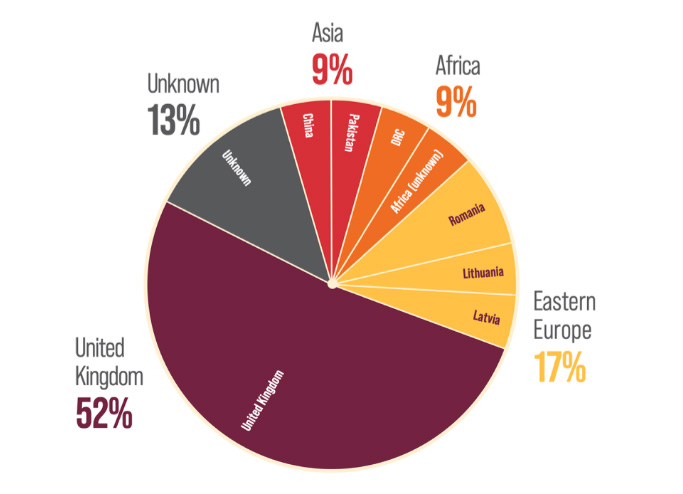
REGION OF ORIGIN OF PEOPLE LIVING WITH HBV IN WEST SCOTLAND (N=23)16

image3

Figure drawn from Jackson C, et al. 201816

a Two centres used clinic-led testing but there were insufficient data to determine the rate of testing.
b Centre 1: HDV testing performed over a 3-month period (June 2012–August 2012) in people living with HBV (n=168) attending the centre clinics. HDV seroprevalence was 6% (n=4/67) and the screening rate was 40% (n=67/168). Centre 2: Reflex-led anti-HDV testing of all first HBsAg positive samples performed between 2001 and 2012. HDV seroprevalence was 4.5% (n=158/3543) and screening rate was 99.4% (n=3543/3563). Comparisons should not be made between centres due to differences in populations. Centre 3 and Centre 4, used clinic-led testing but there were insufficient data to determine the rate of testing.
c Active HDV infection was defined by detectable HDV RNA
d HDV genotype was not known in all the patients presented within this figure.

Chronic HDV infection: Morbidity and mortality


Chronic HDV infection has the highest mortality rate of any viral hepatitis.17

Patients with chronic HDV infection experience rapid progression towards liver failure.17 In addition, compared to individuals living with HBV alone, patients also infected with HDV are at a higher risk of developing more severe liver disease, including:8,17-19

  • 3-6x more likely to develop liver cancer
  • 2-3x more likely to develop cirrhosis.

As HDV only infects those living with HBV,1 it is important to focus screening efforts of HDV on all patients with HBV.

HDV management: Therapeutic challenges


The goal of HDV treatment is to suppress HDV replication, which is usually associated with the normalisation of liver enzymes.20

Nucleos(t)ide analogue treatments for HBV are not effective against HDV,20,21 but achieving HDV treatment goals aims to prevent long-term complications of HDV infection, including:5

  • Cirrhosis
  • Hepatocellular carcinoma
  • Liver transplantation
  • Liver-related death.

HDV screening


HDV screening and testing rates are low,15,22 but because of the severity of chronic HDV infection,8,17 screening is urgently needed.11

Screening HBsAg-positive individuals for HDV diagnosis involves 2 steps:8,23
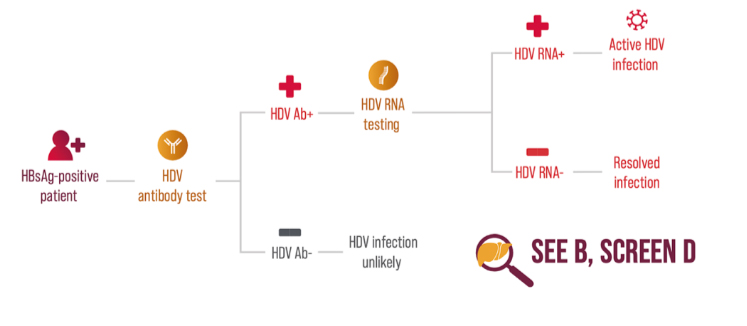
  • Start with an HDV antibody test
  • If positive, confirm with a HDV RNA test.
image4

Guidelines

Screening those who are HBsAg positive for HDV helps facilitate the next steps in HDV management.24,25

The European Association for the Study of the Liver (EASL) recommends HDV screening for all those who are HBsAg positive and re-testing for anti-HDV antibodies in those who are HBsAg positive whenever clinically indicated; re-testing may be performed yearly in those remaining at risk of infection.26

NICE recommend HDV screening in primary care for all those who are HBsAg positive.27

HEPCLUDEX® (bulevirtide) is indicated for the treatment of chronic hepatitis delta virus (HDV) infection in plasma (or serum) HDV-RNA positive adult and paediatric patients 3 years of age and older weighing at least 10 kg with compensated liver disease.28

Hepcludex logo

HEPCLUDEX® (bulevirtide) Safety Information*28

  • The most frequently reported and very common (≥ 1/10) adverse reactions are headache, pruritus, injection site reactions**, and increase in bile salts; increase in bile salts were usually asymptomatic and reversible after discontinuation of treatment.28
  • Common adverse reactions reported (≥ 1/100 to < 1/10) are eosinophilia, fatigue, influenza-like illness, dizziness, nausea and arthralgia.28
  • An uncommon adverse reaction (≥ 1/1,000 to < 1/100) reported is hypersensitivity, including anaphylactic reaction.†28
  • The most frequently reported serious adverse reaction is reactivation of HDV and HBV infections and exacerbation of hepatitis after discontinuation of Hepcludex, possibly related to virologic rebound after treatment discontinuation.28

It is important to consult the HEPCLUDEX® SmPC before prescribing. This contains important information on contraindications, method of administration, prescribing in special populations, use in pregnancy and breast-feeding and drug interactions.

*The adverse reactions are based on pooled data from clinical studies in adults and post-marketing experience.28
**Includes injection site erythema, injection site reaction, injection site pain, injection site induration, injection site rash, injection site swelling, injection site haematoma, injection site pruritus and injection site dermatitis.28
†Adverse reactions identified through pooled data from clinical studies and post-marketing surveillance.28

▼This medicinal product is subject to additional monitoring. This will allow quick identification of new safety information. Adverse events should be reported to Gilead at [email protected] or +44 (0) 1223 897500.

Abbreviations:

Ab = antibody; HBsAg = hepatitis B surface antigen; HBV = hepatitis B virus; HDAg = hepatitis D antigen; HDV = hepatitis D virus; NICE = National Institute for Health and Care Excellence; RNA = ribonucleic acid.

References
  1. WHO World Health Organization. Hepatitis D. June 24, 2022. https://www.who.int/news-room/fact-sheets/detail/hepatitis-d Accessed February 2026.
  2. Lok AS, et al. Endpoints and new options for treatment of chronic hepatitis D. Hepatology. 2021;74(6):3479–3485. doi:10.1002/hep.32082.
  3. Urban S, et al. Hepatitis D virus in 2021: virology, immunology and new treatment approaches for a difficult-to-treat disease. Gut. 2021;70(9):1782–1794. doi: 10.1136/gutjnl-2020-323888.
  4. Greco-Stewart VS, et al. The hepatitis delta virus RNA genome interacts with the human RNA polymerases I and III. Virology. 2009;386(1):12–15. doi:10.1016/j.virol.2009.02.007.
  5. Farci P, Niro GA. Current and future management of chronic hepatitis D. Gastroenterol Hepatol (NY). 2018;14(6):342–351.
  6. Lange M, et al. Hepatitis Delta: Current Knowledge and Future Directions. Gastroenterology & Hepatology. 2022;18(9):508–520.
  7. Niro GA, et al. Hepatitis delta virus: From infection to new therapeutic strategies. World J Gastroenterol. 2021;27(24):3530–3542. doi: 10.3748/wjg.v27. i24.3530.
  8. Da BL, et al. Hepatitis D infection: from initial discovery to current investigational therapies. Gastroenterol Rep (Oxf). 2019;7(4):231–245. doi:10.1093/gastro/goz023.
  9. Campbell C, et al. Estimating the epidemiology of chronic Hepatitis B Virus (HBV) infection in the UK: what do we know and what are we missing? medRxiv. 2022. doi:10.11 01/2022.04.12.22273568.
  10. Rizzetto M, et al. The changing context of hepatitis D. J Hepatol. 2021;74(5):1200–1211. doi: 10.1016/j.jhep.2021.01.014.
  11. Miao Z, et al. Estimating the Global Prevalence, Disease Progression, and Clinical Outcome of Hepatitis Delta Virus Infection. J Infect Dis. 2020;221(10):1677–1687. doi:10.1093/infdis/jiz633.
  12. Stockdale AJ, et al. The global prevalence of hepatitis D virus infection: Systematic review and meta-analysis. J Hepatol. 2020;73:523–532. doi: 10.1016/j.jhep.2020.04.008.
  13. Miao Z, et al. Estimating the Global Prevalence, Disease Progression, and Clinical Outcome of Hepatitis Delta Virus Infection (supplementary appendix). J Infect Dis. 2020;221(10):1677–1687.
  14. Stockdale AJ, et al. The global prevalence of hepatitis D virus infection: Systematic review and meta-analysis (supplementary appendix). J Hepatol. 2020;73:523–532.
  15. El Bouzidi K, et al. Hepatitis delta virus testing, epidemiology and management: a multicentre cross-sectional study of patients in London. J Clin Virol. 2015;66:33–37. doi:10.1016/j.jcv.2015.02.011.
  16. Jackson C, et al. Epidemiology and patient characteristics of hepatitis D virus infection in the West of Scotland 2011-2016. J Viral Hepat. 2018;25(11):1395–1396. doi:10.1111/jvh.12939.
  17. Romeo R, et al. Hepatitis delta virus and hepatocellular carcinoma: an update. Epidemiol Infect. 2018;146(13):1612–1618. doi:10.1017/S0950268818001942.
  18. Abbas Z, et al. Hepatitis D and hepatocellular carcinoma. World J Hepatol. 2015;7(5):777–786. doi:10.4254/wjh.v7.i5.777.
  19. Fattovich G, et al. Influence of hepatitis delta virus infection on morbidity and mortality in compensated cirrhosis type B. The European Concerted Action on Viral Hepatitis (Eurohep). Gut. 2000;46(3):420–426. doi:10.1136/gut.46.3.420.
  20. Wedemeyer H, et al. Treatment of hepatitis delta. Clin Liv Dis. 2013;2(6):237–239.
  21. Yurdaydin C. Treatment of chronic delta hepatitis. Semin Liver Dis. 2012;32(3):237–244. doi:10.1055/s-0032–1323629.
  22. Htet H, et al. P194 The burden of hepatitis D infection in East London. Gut. 2021;70:A143–A144. doi.org/10.1136/gutjnl-2020-bsgcampus.269.
  23. Terrault NA, et al. Update on prevention, diagnosis, and treatment of chronic hepatitis B: AASLD 2018 hepatitis B guidance. Hepatology. 2018;67(4):1560–1599. doi:10.1002/hep.29800.
  24. Terrault N, Ghany M. Enhanced Screening for Hepatitis D in the USA: Overcoming the Delta Blues. Dig Dis Sci. 2021;66:2483–2485. doi.org/10.1007/s1062002006584.
  25. Ahn J, Gish RG. Hepatitis D Virus: A Call to Screening. Gastroenterol Hepatol. 2014;10(10):647–686. PMCID: PMC4988222.
  26. European Association for the Study of the Liver. EASL Clinical Practice Guidelines on hepatitis delta virus. J Hepatol. 2023;79(2):433–460. doi.org/10.1016/j.jhep.2023.05.001.
  27. National institute for health and care excellence (NICE). Hepatitis B (chronic): diagnosis and management.
    Clinical guideline 165. 26 June 2013 (updated 20 October 2017). https://www.nice.org.uk/guidance/cg165 Accessed February 2026.
  28. UK HEPCLUDEX® Summary of Product Characteristics

UKI-HPX-0206 | February 2026