
You have been successfully logged out.


It is characterised by the destruction of the bile ducts, subsequent cholestasis and progressive fibrosis which lead to cirrhosis.3 If left untreated, PBC may ultimately lead to end-stage liver disease and its related complications.4
Up to 70–80% of patients with PBC experience pruritus2,7
Almost 90% of patients with PBC in the UK receive UDCA as first-line treatment, but nearly one third receive a suboptimal dose (<13 mg/kg/day).10
Baseline EQ-5D-5 level responses from 146 adult patients with PBC and mild, moderate or severe pruritus (GLIMMER)*12
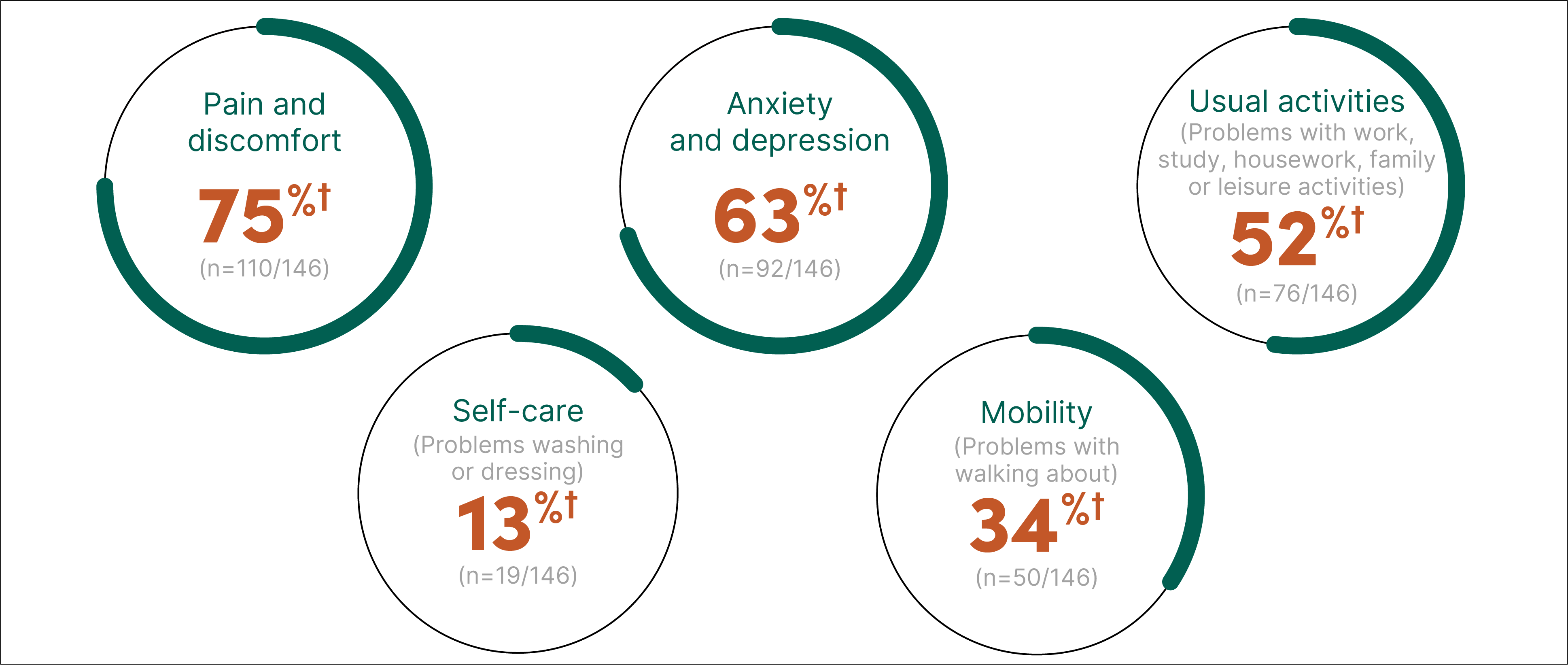
*GLIMMER was a multicentre, randomised, double-blind, placebo-controlled, parallel-group, phase IIb, dose-finding study in 146 adult patients with PBC and pruritus (n=35, 76, 37; mild, moderate, severe pruritus respectively).12
‡On day 1, patients entered an initial, 4-week, single-blind, placebo run-in to establish baseline symptoms. Adults with proven PBC and moderate-to-severe cholestatic pruritus were considered for enrolment. Evaluation of health status was undertaken using the EQ-5D-5L health domains and utility index assessed on day 1 (entry to placebo run-in), baseline and week 16. Limitations of the study: HRQoL and pruritus data were collected as prespecified endpoints, but the study was not designed to specifically assess the link between them. Analyses were performed in a clinical trial setting, not the real world. In some subgroups, patient numbers are small, which may limit the strength of the conclusions.12
†Percentage is the combined total number of patients with mild, moderate or severe pruritus reporting slight, moderate, severe, or extreme/unable to complete activity problems. However, across all domains, patients with severe pruritus at baseline were more impacted, compared with patients who had mild or moderate pruritus.
‡EQ-5D-5L data missing for 1 patient in the severe subgroup (n=36).12
The prevalence of PBC is considerably higher in women than men (9:1),2,15 but appears to have stabilised in women following several years of increase.2
The disease may recur in up to a third of patients (35%) after a liver transplant, requiring further treatment and management.2,16
Additionally, complications associated with PBC increase healthcare costs.*17
*Data assessing the cost of liver transplants in patients with PBC are lacking. However, the average cost per patient with hepatitis C who has undergone liver transplantations, from assessment to 2 years post-transplant, exceeds £110,000.19


ALP levels >1.67 × ULN are associated with adverse liver-related outcomes, such as:24-26

Cholestasis

Bile duct destruction

Disease progression
In patients with adequate response to UDCA, persistent ALP elevation above 1.0 × ULN is associated with poorer outcomes.21
10-year transplant-free survival rates from a GLOBAL PBC Study Group analysis (N=2555) were:26
93% in patients with ALP ≤1 × ULN
86% in patients with ALP 1.0–1.67 × ULN
*Limitations of the GLOBAL PBC Study should be noted: whereas total serum bilirubin levels in healthy patients are primarily composed of unconjugated bilirubin, it is predominantly conjugated in patients with PBC. The real-world nature of the cohort only allowed evaluation of total bilirubin, since independent measurements of the conjugated and unconjugated forms are not part of routine standard of care.26
EQ-5D-5L = European Quality of Life 5 Dimensions 5 Levels; HRQoL = Health-Related Quality of Life; QoL = quality of life; PBC = primary biliary cholangitis. ALP = alkaline phosphatase; UDCA = ursodeoxycholic acid; ULN = upper limit of normal.
UKI-LIV-0146 | February 2026
Adverse events should be reported.
For the UK, reporting forms and information can be found at www.mhra.gov.uk/yellowcard or via the Yellow Card app (download from the Apple App Store or Google Play Store). For IE, reporting forms and information can be found at www.hpra.ie and can be reported to HPRA on +353 1 6764971. Adverse events should also be reported to Gilead to [email protected] or +44(0) 1223 897500 or +353(0) 21 482 5999.
