
You have been successfully logged out.
Across a total of 445 DAA-experienced chronic HCV patients in both trials, Sofosbuvir/Velpatasvir/Voxilaprevir Gilead achieved cure in 96–98% of cases.1
High cure rates of over 90% were demonstrated across HCV genotypes.1
EASL defines cure as SVR, i.e. undetectable viral RNA after treatment completion.2
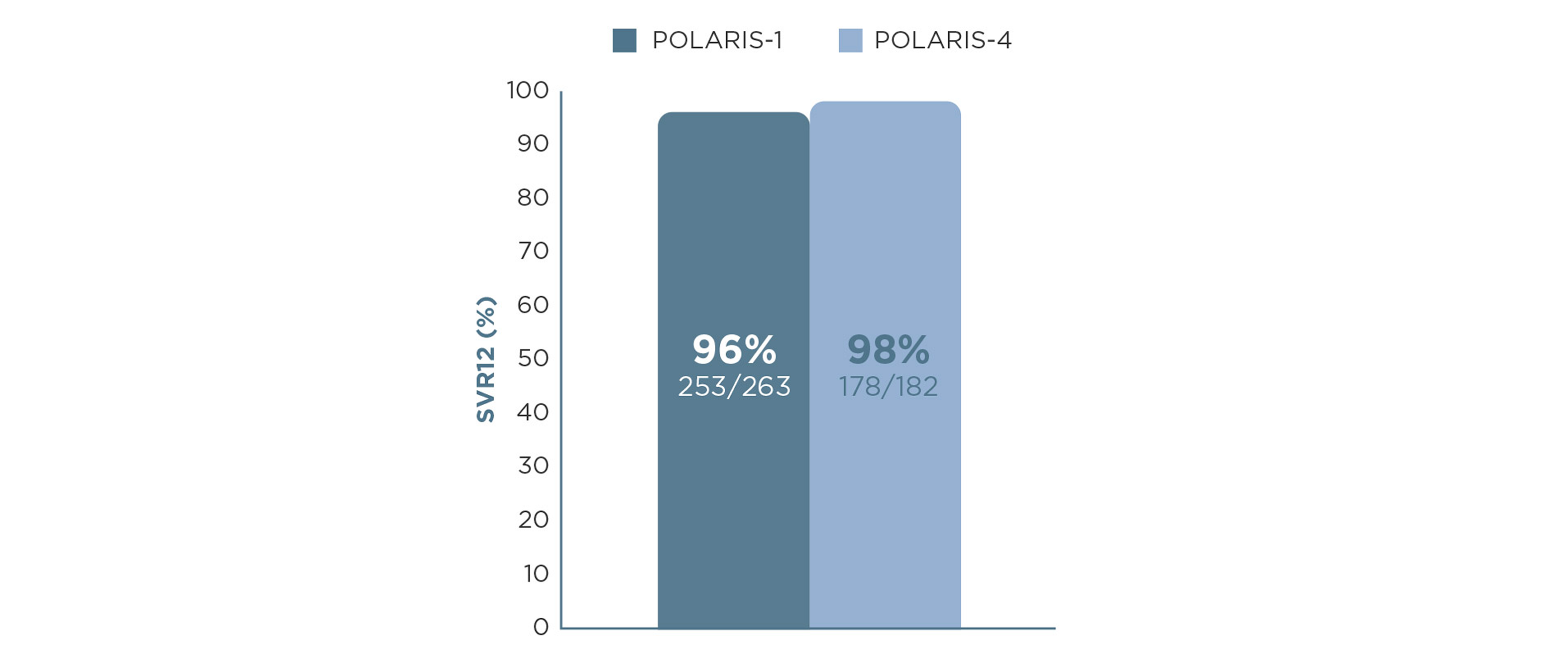
SVR12, sustained virological response at 12 weeks after treatment (any genotype).
POLARIS-1 was a randomised, double-blind (patients were blinded until week 4) placebo controlled, multicentre trial evaluating 12-week treatment with Sofosbuvir/Velpatasvir/Voxilaprevir Gilead in 415 patients with HCV. All patients had to be previously treated with an NS5A inhibitor and have had a virologic failure after completing at least 4 weeks of treatment. Non-GT-1 patients were assigned to receive Sofosbuvir/Velpatasvir/Voxilaprevir Gilead, and randomisation was stratified according to cirrhosis status. Patients received either a fixed dose of Sofosbuvir/Velpatasvir/Voxilaprevir Gilead or a matching placebo once daily. The primary endpoints were percentage of participants with SVR at 12 weeks and percentage of participants who permanently discontinued due to AEs.1
POLARIS-4 was an open-label, randomised, multicentre study in 333 patients with HCV, receiving either Sofosbuvir/Velpatasvir/Voxilaprevir Gilead or Sofosbuvir/Velpatasvir Gilead once daily for 12 weeks. All patients had to have been previously treatment with any DAA regimen that did not include an NS5A inhibitor. Those with non-GT-1–3 HCV or unknown genotypes were put into the Sofosbuvir/Velpatasvir/Voxilaprevir Gilead group. Randomisation was stratified by cirrhotic status and genotype. Primary endpoints were percentage of those who permanently discontinued due to AEs and those who achieved SVR at 12 weeks.1
Across both trials, patients were assessed for HCV RNA levels at Weeks 2, 4, 8 and 12 during treatment, and again at 4 and 12 weeks after treatment completion.1
To certain patients, elimination may mean freedom from extra burden. To others, elimination means
freedom from reinfection.
Sofosbuvir/Velpatasvir Gilead delivers high cure (94%, n=97/103) even though real-world settings can
vary.4 And with Sofosbuvir/Velpatasvir/Voxilaprevir Gilead, you can offer patients a
treatment
specifically licensed after DAA failure.1,5
Sofosbuvir/Velpatasvir Gilead and Sofosbuvir/Velpatasvir/Voxilaprevir Gilead offer a simplified route to HCV elimination.
Sofosbuvir/Velpatasvir Gilead (400 mg/100 mg tablets)
Prescribing InformationSofosbuvir/Velpatasvir Gilead is indicated for the treatment of chronic hepatitis C virus (HCV) infection in patients 3 years of age and older.

A study using a veterans registry of over 500 patients experienced with DAA treatment found that Sofosbuvir/Velpatasvir/Voxilaprevir Gilead was able to cure over 90% of cases in a real-world setting.6
The cross-genotype efficacy of Sofosbuvir/Velpatasvir/Voxilaprevir Gilead can support the ambition to leave no patient behind on the path to HCV elimination.6
DAA = direct-acting antiviral; EASL = European Association for the Study of the Liver; GT =
genotype; HCV = hepatitis C virus;
NS5A = nonstructural protein 5A; RNA = ribonucleic acid; SVR =
sustained virologic response.
UKI-VSV-0034 October 2026
Adverse events should be reported.
For the UK, reporting forms and information can be found at www.mhra.gov.uk/yellowcard or via the Yellow Card app (download from the Apple App Store or Google Play Store). For IE, reporting forms and information can be found at www.hpra.ie and can be reported to HPRA on +353 1 6764971. Adverse events should also be reported to Gilead to [email protected] or +44(0) 1223 897500 or +353(0) 21 482 5999.